Posts

Showing posts with the label Researching the brain

AQA A-LEVEL: Biopsychology - Brain Plasticity and Recovery after Trauma
Image
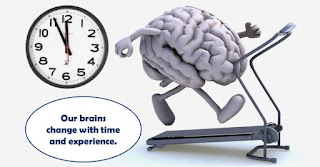
BRAIN PLASTICITY AND RECOVERY AFTER TRAUMA BRAIN PLASTICITY: Brains ability to change and adapt mentally and functionally as a result of experience and new learning. EXPERIENCE EXPECTANT PLASTICITY: Changes in the brain taking place in infancy We have 15,000 synaptic connections by 2-3yrs through synaptogenesis which is double what we have as an adult. Not all synaptic connections are used so some are deleted by cognitive pruning which strengthens the frequently used synapses. EXPERIENCE DEPENDENT PLASTICITY: When the brain continues to create new neural pathways and alter existing ones as a result of learning and life experiences. Through...  Synaptogenesis - New synapses form through life but mostly in infancy Neurogenesis - New neurones form. Occurs in infancy and adulthood. Synaptic Pruning - Synapse elimination which occurs in early childhood and the onset of puberty - occurs less in adulthood.  COMPUTER GAMING - KUHN et al  ...

AQA A-LEVEL: Biopsychology - Split Brain Research

Image
SPLIT BRAIN RESEARCH BACKGROUND In cases of severe epilepsy, surgery can be done to remove the CORPUS COLLUSUM which connects the left and right HEMISPHERES. CORPUS CALLOSUM is responsible for hemispheric communication through nerve fibres called commission fibres In split brain pts, hemispheric communication does not occur  PROCESSES INVOLVED IN SPLIT BRAIN RESEARCH Split brain pts have a split visual field. Pts sat in front of a screen and were asked to gaze at a fixed point in the centre.  Visual stimuli projected to the right visual field (RVF) or left visual field (LVF) at a high speed, so there's no chance for them to move their head ~~> They're only able to process the image in the visual field it was placed in. FINDINGS OF SPERRY RESEARCH When words were projected to LVF (goes to the Right hemisphere) the words did not register as the left hemisphere is for language so words need to be presented to the RVF to be registered. EVAL...

AQA A-LEVEL: Biopsychology - Researching the Brain

Image
RESEARCHING THE BRAIN POST MORTEM  A person's body + brain is examined after death. Done to see where the damage had occurred in the brain and to see if behaviour done by individual prior to death can be explained. The brain can be sliced into thin sections and studied under a microscope to detect abnormalities. DETAILED EXAMINATION You can see anatomical aspects which can't be seen w/ non-invasive techniques, we can look at deeper regions of the brain RESEARCH SUPPORT - Harrison 2000 This method was important for our understanding of schiz. He suggested structural and neurochemical abnormalities linked to schiz were first identified using post-mortem  METHOD IS RETROSPECTIVE The problem with comparing function to before death is that there is little info about how the individual functioned before they died. Researchers cannot follow up on potential brain abnormalities and cog function BRAIN CHANGES after death Because of this, the fi...